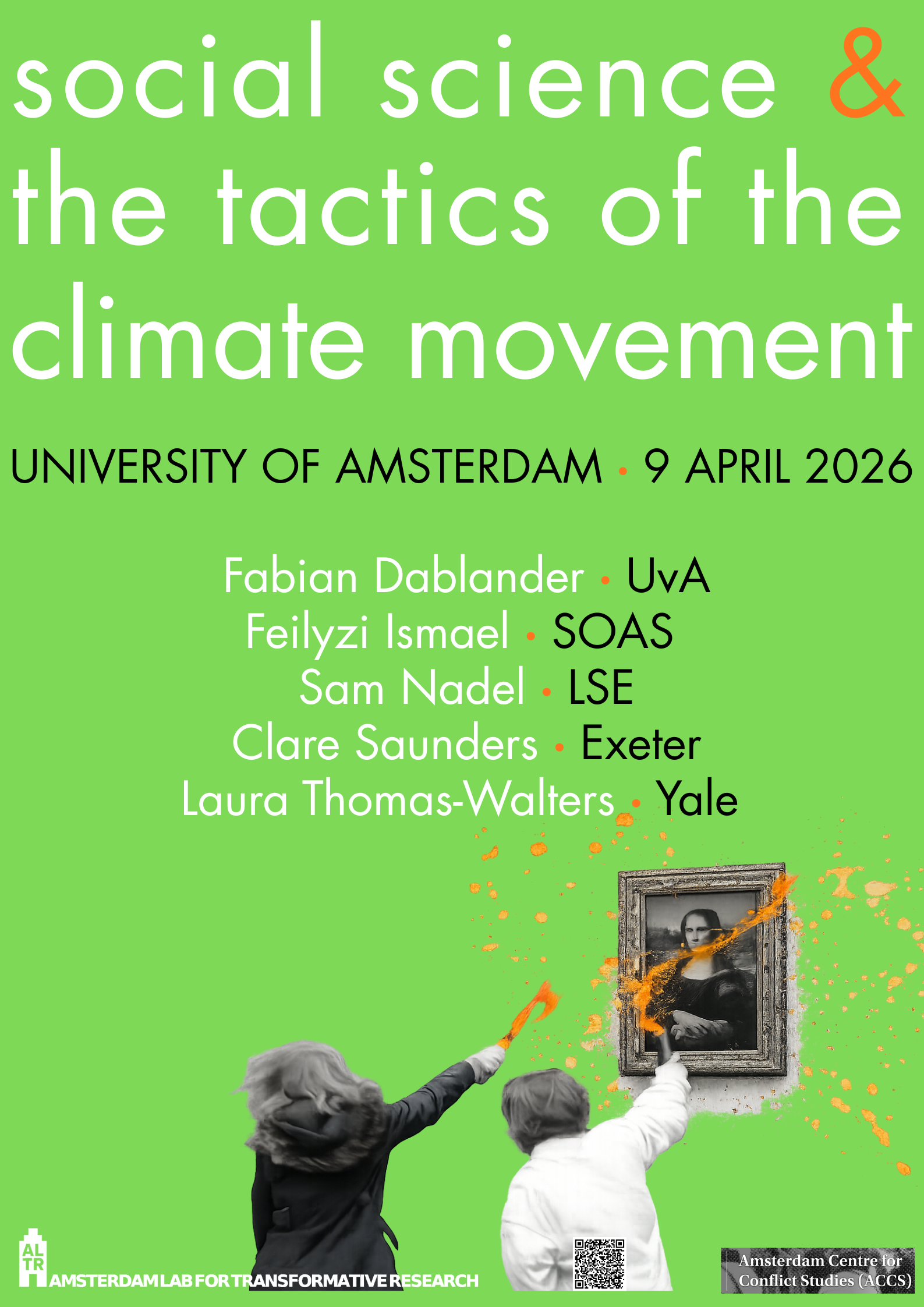
Social Science and the Tactics of the Climate Movement
Date: Thursday 9 April
Location: BG2 0.8 (10:00-15:00) + BG2 0.2 (15:00-17:00).
Debates about climate justice have long focused on the movement’s goals and their feasibility. A new and urgent discussion now concerns the legitimacy and efficacy of increasingly disruptive climate tactics. As protests intensify, questions about strategy, ethics, and democratic order have come to the fore.
This workshop convenes empirical scholars and political theorists to assess how we should evaluate disruptive strategies, what evidence can measure their efficacy and political costs, and how they fit within broader debates about order, violence, and democracy. It asks whether climate movements simply contest the status quo—or seek to reconstitute democratic order itself.
Programme:
Session 1: 10:00-11:00
Fabian Dablander (University of Amsterdam): “From Moral Motivations to Material Interests: Building a Mass Climate Movement through Transformative Adaptation”
Session 2: 11:00-12:00
Feyzi Ismael (SOAS London): “Key Structural Weaknesses of the Climate Movement”
Lunch Break: 12:00-13:00
Session 3: 13:00-14:00
Sam Nadel (London School of Economics): "What was the impact of the Swedish Restore Wetlands campaign"
Session 4: 14:00-15:00
Clare Saunders (University of Exeter): “Grassroots voices and the need for a Climate Majority”
Coffee Break/Room Change: 15:00-15:30
Session 5: 15:30-16:30
Laura Thomas-Walters (Yale University) : "Impacts of climate activism: A review of 50 recent studies evaluating the effects of collective climate action on public opinion, media coverage, the political system, and environmental outcomes"
Roundtable: 16:30-17:00
This event is supported by the Amsterdam Centre for Conflict Studies and is in collaboration with the Amsterdam Lab for Transformative Research and the Challenges to Democratic Representation Programme Group of the UvA’s Department of Political Science.